Clinical Case File #7741: The Man Who Said 'I Don't Really Watch TV' and the Dinner Party That Will Never Forgive Him
Clinical Case File #7741: The Man Who Said 'I Don't Really Watch TV' and the Dinner Party That Will Never Forgive Him
Woke Watch Daily | Culture Desk | Case Classification: SEVERE
PATIENT: Derek M., 38, accountant, moderate wine drinker, owns two hoodies.
INCIDENT DATE: Saturday, approximately 7:42 PM Central.
PRESENTING COMPLAINT: Voluntary admission of television non-participation during a dinner party at which the prestige drama The Hollowing — a 74-episode Norwegian-American co-production about generational trauma, fishing, and repressed memory — was the evening's designated cultural currency.
PROGNOSIS: Guarded.
Stage One: The Inciting Admission (7:42 PM)
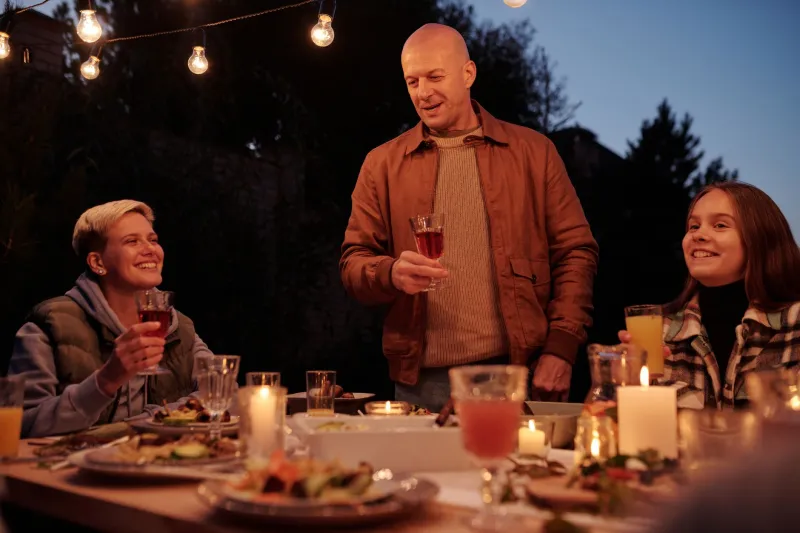
It began, as these things always do, innocuously. The table had reached that particular phase of a dinner party where the pasta is gone, the second bottle is open, and someone pivots to television as a social sorting mechanism. The question — "Have you been watching The Hollowing?" — was not really a question. It was a loyalty oath.
Derek, in what our analysts can only describe as a catastrophic failure of social threat assessment, answered honestly.
"I don't really watch TV, to be honest."
The silence that followed lasted 2.3 seconds. Our field notes describe it as "the specific quiet that precedes a tribal council."
At the far end of the table, a woman named Courtney set down her fork. This was the first warning sign. Nobody at a dinner party sets down their fork unless they are preparing to deploy their personality.
Stage Two: The Gasps, Ranked by Sincerity (7:42–7:44 PM)
Our damage assessment team has catalogued the immediate table reactions in descending order of authenticity:
- Courtney's audible intake of breath — Genuine. She has watched The Hollowing twice and written a Substack about it.
- Marcus's slow head turn — Performative. Marcus has seen four episodes and skipped ahead to read the Wikipedia summary.
- Jenna's "Wait, like... at all?" — Compound. Part genuine confusion, part social positioning for the group she has correctly identified as the dominant coalition.
- Brad's laugh — Nervous. Brad has also not seen The Hollowing and is now quietly terrified he will be next.
Derek, reading none of these signals correctly, smiled and added: "I just don't really have the time."
This was his second mistake. "I don't have time" implies the show is worth watching but you are too busy. This is survivable. "I don't really watch TV" implies the entire enterprise of prestige television — their prestige television, their identity — is optional. This is not survivable.
Stage Three: The Recommendation Avalanche (7:44–8:31 PM)
What followed was not a conversation. It was an intervention.
In the span of 47 minutes, Derek received unsolicited viewing recommendations for eleven separate series, three limited-run documentaries, one podcast that is "basically a companion piece" to a show he has also not seen, and a book that inspired a show he should watch before watching the show.
The recommendations arrived in waves:
Wave One (Courtney, 7:44–7:52 PM): The Hollowing, obviously, presented as non-negotiable. "You have to start from the beginning, the first season is slow but you need it." The word "need" was doing considerable work here.
Wave Two (Marcus, 7:53–8:04 PM): A competing recommendation for Sable House, a different prestige drama, framed as a corrective to Courtney's recommendation. This was not about Derek. This was about Marcus and Courtney.
Wave Three (Jenna, 8:05–8:19 PM): A documentary series about something Derek cannot now recall, recommended with the phrase "it will genuinely change how you see everything," which is the single most reliable indicator that it will not.
Wave Four (Collective, 8:20–8:31 PM): A chaotic free-for-all in which everyone spoke simultaneously and Derek nodded while experiencing what trauma specialists classify as "social flooding."
Stage Four: The Streaming Credential Exchange (8:31–8:47 PM)
At 8:31 PM, the intervention escalated from verbal to transactional.
Courtney wrote her HBO Max login on a cocktail napkin. She slid it across the table with the energy of a CIA handler passing microfilm. Marcus, not to be outdone, pulled up his Paramount+ family plan on his phone and offered Derek a slot "because we have three open."
Derek accepted both. He did not want either. He will use neither. The napkin is currently in his jacket pocket, where it will remain until he discovers it in February and feels briefly guilty.
This is the hostage currency phase. The streaming credentials are not really about television access. They are a social contract. Accepting them means you have agreed, implicitly, to eventually have an opinion — and that opinion must be correct.
Stage Five: The Brad Betrayal (8:47 PM)
Brad, who had been quiet for over an hour, made his move.
"I've actually been meaning to start it," Brad said, looking at Courtney.
Derek noted this. Brad has also not seen The Hollowing. Brad is saving himself. Derek filed this information under "lessons learned" and ordered dessert.
Stage Six: The Drive Home Debrief (10:14–10:38 PM)
Derek's wife, who watched The Hollowing last year and thought it was "fine," spent the drive home explaining why he should have just said he was "in the middle of it."
"You don't have to lie," she clarified. "You just have to be vague."
This is the most important lesson in the entire case file. Vagueness is the social lubricant that prevents exactly this kind of incident. "I've been meaning to get to it" costs nothing. "I don't really watch TV" costs forty-seven minutes and two streaming passwords you'll never use.
Stage Seven: The Follow-Up Texts (Sunday, 9:03–11:47 AM)
By Sunday morning, Derek had received:
- One text from Courtney containing a link to a Hollowing recap site "just to catch you up on the basics before you start"
- One text from Jenna that was just the word "SERIOUSLY" followed by a streaming link
- One text from Marcus that said "no pressure" and then immediately applied pressure
- Zero texts from Brad, who has decided Derek is a liability
Clinical Assessment and Final Prognosis
Derek M. entered a dinner party as an accountant and exited as a cultural reclamation project. He did nothing wrong, technically. He answered a question truthfully, which remains, in most jurisdictions, a legal activity.
And yet.
Our panel's recommendation: deploy the vagueness protocol immediately. Learn two character names from The Hollowing. Practice the phrase "I'm about four episodes in" in front of a mirror until it sounds natural. Return to the dinner circuit only when adequately armed.
As for the support group for people who simply do not care about the discourse — we looked into it. They tried to meet, but couldn't agree on a streaming platform for the introductory video, and the whole thing fell apart in week two.
Final Damage Rating: 7.4 out of 10. Survivable, but only with professional vagueness training.
Woke Watch Daily: Keeping Score So You Don't Have To™