Two Inches of Teriyaki Chicken on a Toothpick: A Field Report from the Most Contested Square Footage in American Retail
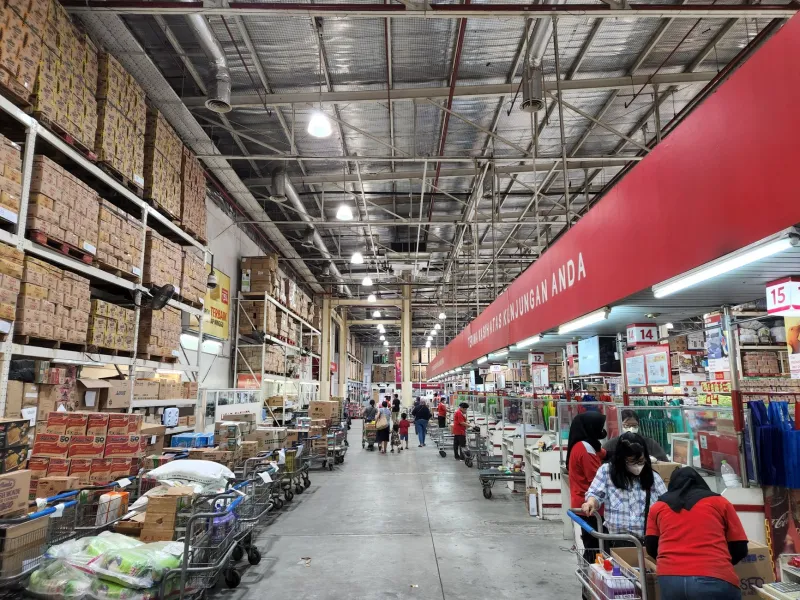
It is 11:47 on a Saturday morning at Costco Wholesale, and the woman at Sample Station 7 has just taken her third miniature cup of mango smoothie.
She knows what she has done. The retired couple three feet behind her knows what she has done. The Costco employee in the paper hat knows what she has done and is maintaining a carefully neutral expression that has been honed through hundreds of similar incidents and possibly some light PTSD. A man in a fleece vest near the back of the loose formation that passes for a line has begun to breathe audibly through his nose.
This is not a minor transaction. This is a reckoning.
Welcome to the Costco sample station, the most ethnographically rich and psychologically volatile forty square feet in American consumer culture. Our field team was embedded for ninety minutes across three sample locations in a single suburban warehouse location. What follows is a complete account of what we observed, annotated for context.
The Unwritten Code and Its Violent Enforcement
No posted sign at Costco specifies that a customer is entitled to exactly one sample. The entire system operates on implied social contract — a set of norms so obvious to their participants that articulating them feels redundant, and so routinely violated that the violation triggers a response disproportionate to any rational assessment of the stakes.
The baseline agreement, as understood by the regulars, is as follows: one sample per pass. You may circle back after a reasonable interval — estimates vary, but the working consensus among experienced Costco shoppers appears to be somewhere between "after you've gone to another aisle" and "after a full lunar cycle" — and claim a second sample without significant social consequence. Taking a second sample from the same station without moving is a gray area that generates visible tension. Taking a third without any intervening movement is, within this microculture, roughly equivalent to cutting in the express lane with twenty-three items.
The enforcement mechanism is entirely social and therefore entirely relentless.
There are no fines. There is no official complaint process. What there is, is a retired man from the Phoenix suburbs who has been shopping at this specific Costco for eleven years and has developed opinions about sample etiquette that he will absolutely share with his wife at a volume calibrated to be overheard.
A Taxonomy of Sample Station Participants
In ninety minutes of observation, our team identified seven distinct behavioral profiles among sample station visitors, presented here in order of increasing community controversy.
The Purposeful Sampler takes one sample, evaluates it with genuine interest, checks the product packaging, and either places the item in their cart or moves on. This person is functionally invisible to the ecosystem because they have committed no offense and generated no drama. They are the control group.
The Apologetic Circler takes one sample, leaves, returns approximately eight minutes later, and takes a second while making brief eye contact with the employee and nodding in a way that communicates acknowledgment of the situation. Accepted by all parties.
The Oblivious Tourist is visiting Costco for the first time, possibly as a guest of a member, and approaches the sample station with the unguarded enthusiasm of someone who does not yet understand that they are being watched. Takes one sample. Looks delighted. Takes another. The watching begins.
The Parent With Stroller takes a sample, breaks it in half for the toddler, takes another sample, and is operating under the implicit cultural exemption that has been extended to parents of small children in public food situations since approximately the Eisenhower administration. Mostly tolerated. Occasionally resented by the fleece vest demographic.
The Deliberate Double-Dipper takes one sample, waits approximately forty-five seconds while appearing to examine a nearby pallet of paper towels, then returns for a second. This person is aware of the social contract and is consciously testing its elasticity. They generate low-level ambient tension but not active confrontation.
The Unapologetic Third-Taker — the woman at Station 7 — takes three samples in a single visit without apparent awareness that this is a documented social infraction. OR — and this is the more psychologically interesting possibility — with complete awareness and a conscious decision not to care. The community cannot determine which scenario is operative, and the ambiguity is the source of maximum agitation.
The Vigilante is the retired man in the fleece vest. He has taken exactly one sample. He has been standing near the station for six minutes. He is not waiting for more samples. He is waiting to see what happens next.
The Class Anxiety Dimension
It would be incomplete to discuss the Costco sample wars without acknowledging the submerged class dynamics that give the conflict its particular charge.
Costco is a genuinely democratic retail environment in the sense that its membership spans a remarkable income range — the same warehouse serves the budget-conscious family buying in bulk and the affluent suburban household that shops there ironically and ends up spending $400 on a cashmere sweater and a case of Kirkland Signature Cabernet. This cross-class mingling, normally invisible in American retail geography, becomes suddenly legible at the sample station.
The unspoken accusation leveled at the Three-Sample Woman is not merely that she has violated protocol. It is that she is taking more than her share of a free thing, which in the American cultural imagination carries a specific weight that has very little to do with teriyaki chicken. The sample is functionally worthless. The principle, apparently, is not.
The fleece vest man has a $1,400 annual income from dividends. The Three-Sample Woman may be feeding two kids on a single income. Neither of these facts is visible at the sample station. What is visible is the third cup, and the third cup means something.
The Employee Observes All and Says Nothing
The Costco sample employee — whose job is to cook, plate, and distribute small portions of food products while wearing a paper hat and maintaining a serene expression through events that would destabilize a UN peacekeeping mission — deserves specific recognition.
In ninety minutes, the employee at Station 7 witnessed: the Three-Sample Incident, a dispute between two customers about who had been waiting longer, a child who licked a sample and put it back, a man who asked for the sample without the toothpick for dietary reasons that were explained at length, and a woman who wanted to know if the mango smoothie was organic and then launched into a separate conversation about her juice cleanse.
The employee responded to all of these events with the same mild, professionally maintained equanimity. She refilled the samples. She smiled. She said "it's really good" approximately forty times.
She is, by any reasonable measure, a stronger person than anyone reading this article.
The Resolution
The Three-Sample Woman left Station 7 with her third smoothie and moved toward the frozen foods section. The fleece vest man exhaled. The retired couple exchanged a glance that contained an entire conversation. The employee refilled the cups.
Nobody said anything. Nobody ever says anything. That is the genius and the horror of the system.
The sample station reset. A new cycle began. Somewhere in the parking lot, the Three-Sample Woman loaded her car, entirely unbothered, and drove home.
She will be back next Saturday. They will be watching.