The Sacred Journey to Enlightened Suffering
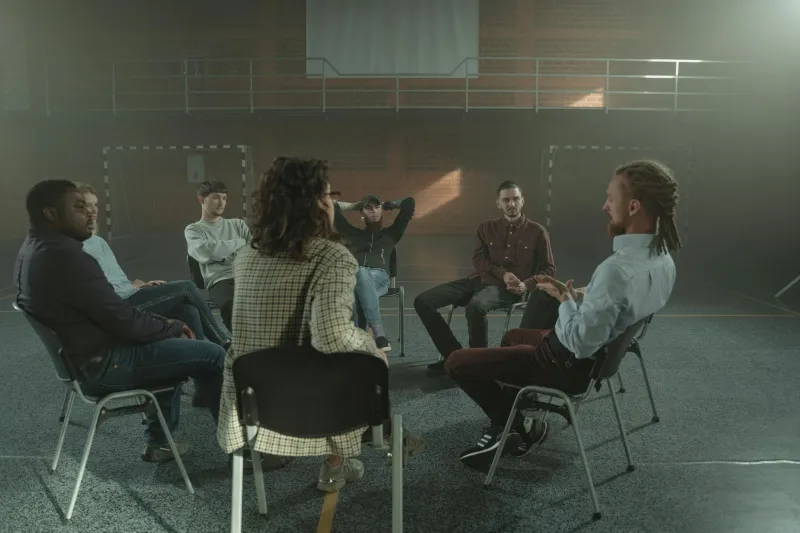
Last weekend, I voluntarily paid $400 to sit in a circle with twelve other adults while a woman named Crystal explained why everything my parents ever did was actually a form of psychological warfare. This wasn't therapy—this was "Conscious Parenting: Awakening the Authentic Parent Within," and according to the promotional materials, my "healing journey" was about to begin.
Spoiler alert: my healing journey mostly involved learning new and creative ways to feel guilty about literally every interaction I've ever had with another human being.
Meet Your Trauma Archaeologist
Crystal—who has a master's degree in something that definitely wasn't around when our parents were raising us—specializes in helping "unconscious parents" recognize the "intergenerational trauma patterns" they're "perpetuating through their conditioning."
Translation: everything you think you know about raising kids is wrong, and also, you're probably emotionally damaging them by existing in their general vicinity.
Crystal's credentials include a certificate from the Institute of Conscious Parenting (located in a strip mall in Sedona), extensive training in "somatic experiencing" (which apparently means paying attention to your feelings), and the kind of serene confidence that can only come from charging desperate parents hundreds of dollars to feel worse about themselves.
 Photo: Institute of Conscious Parenting, via consciouscoparentinginstitute.com
The Opening Ceremony of Self-Flagellation
We began with introductions, which in conscious parenting circles means "trauma sharing disguised as small talk." Each parent shared their "parenting challenges," which Crystal expertly translated into evidence of deep-seated psychological damage.
Sarah, a marketing director, mentioned that her 8-year-old sometimes refuses to clean his room. Crystal nodded knowingly. "I'm hearing some control patterns here. Tell me about your relationship with authority in your family of origin."
Twenty minutes later, Sarah was sobbing about how her father's expectations around chores had created "a scarcity mindset around worthiness" that she was now "unconsciously transmitting" to her son through the simple act of asking him to put away his Legos.
The room erupted in supportive murmurs. Sarah had achieved enlightenment: she now understood that asking children to clean their rooms is actually a form of generational trauma.
The Weaponization of Normal Childhood
According to Crystal's framework, literally every aspect of traditional parenting is actually a trauma response masquerading as normal behavior. Did your parents have bedtimes? Authoritarian control issues. Did they give you chores? Exploitation of child labor. Did they ever say "because I said so"? Emotional invalidation and power abuse.
Did your parents NOT do any of these things? Well, that's neglect and lack of structure, which is also trauma.
The genius of conscious parenting theory is that it's completely unfalsifiable. Every possible childhood experience can be reframed as evidence of damage. It's like psychological astrology—vague enough to apply to everyone, specific enough to feel profound.
The Great Timeout Tribunal
The afternoon session focused on "punishment versus natural consequences," which is conscious parenting speak for "why everything you think you know about discipline is actually child abuse."
Crystal explained that timeouts—those brief moments when overwhelmed parents ask children to sit quietly and think about their choices—are actually "isolation-based punishment that triggers abandonment trauma and teaches children that love is conditional."
Instead, she recommended "connection before correction," which involves sitting with your tantruming child and "holding space for their big feelings" while they scream about not getting a third cookie.
"When your child is dysregulated," Crystal explained, "they need co-regulation, not punishment."
Translation: when your kid is losing their mind, you should lose your mind with them, but in a therapeutic way.
Mike, a dad of three, raised his hand. "But what if they're hitting their sister?"
Crystal smiled the patient smile of someone who has never tried to grocery shop with multiple small children. "That's their nervous system communicating that they have an unmet need. We need to get curious about what they're really asking for."
"They're asking to hit their sister," Mike replied.
"No," Crystal corrected gently. "They're asking for connection. Hitting is just their strategy."
Mike looked like he was reconsidering his entire worldview. Or planning to ask for a refund.
The Emotional Labor Olympics
By hour six, we had learned that conscious parenting requires the emotional bandwidth of a therapist, the patience of a saint, and the energy of someone who definitely doesn't have three kids under ten.
Every interaction with your child becomes an opportunity for deep psychological work. Can't find their shoes? That's a chance to explore their "relationship with responsibility." Don't want to eat vegetables? Time to examine their "autonomy needs" and your own "control patterns around nourishment."
Basically, conscious parenting has turned the simple act of raising children into a PhD program in psychology that you're taking while also working full-time, managing a household, and trying to remember if you fed the dog.
The Privilege Paradox
Here's the thing about conscious parenting: it requires an enormous amount of privilege to implement. You need time to process every interaction, money for therapy when you inevitably fail to be perfectly attuned, and enough emotional bandwidth to treat every childhood meltdown like a graduate seminar in human psychology.
It's a parenting philosophy designed for people who have nannies to actually do the parenting while they attend workshops about how to parent more consciously.
Crystal, for the record, has one child who lives with her ex-husband most of the time.
The Industrial Complex of Inadequacy
The conscious parenting movement has created an entire industry dedicated to making parents feel inadequate about every decision they make. There are coaches, consultants, workshops, retreats, and certification programs, all designed to convince you that parenting—something humans have been doing successfully for thousands of years—is actually incredibly complicated and requires professional intervention.
It's genius, really. Take a normal human experience, pathologize it, then sell the cure.
Feeling overwhelmed by parenting? That's because you're unconscious. Struggling with your toddler's behavior? You're probably repeating trauma patterns. Having a hard time balancing work and family? Sounds like you need to examine your "relationship with worthiness."
For just $400, Crystal can help you understand exactly how damaged you are.
The Guilt Multiplication Effect
Traditional parenting guilt was manageable. You felt bad when you yelled, made a mental note to do better, and moved on. Conscious parenting guilt is nuclear-powered. Every moment of impatience becomes evidence of your unconscious patterns. Every boundary you set is potentially traumatizing. Every decision is a referendum on your emotional evolution.
I left the workshop with a 47-page workbook full of exercises designed to help me "reparent my inner child" while simultaneously parenting my actual children. Because apparently, what overwhelmed parents really need is more homework.
The Verdict from My Inner Child
After eight hours of intensive trauma archaeology, my inner child has some thoughts. Specifically, my inner child would like to file a formal complaint against Crystal and the entire conscious parenting industrial complex for making me feel worse about my childhood, my parenting, and my general existence as a human being.
My inner child also wants to know why we're paying strangers hundreds of dollars to tell us that our parents—who managed to keep us alive without the benefit of Instagram parenting coaches—were actually monsters.
Turns out my inner child is pretty smart. Maybe I should have been listening to her all along.
The Final Analysis
Conscious parenting has taken the beautiful, messy, imperfect art of raising children and turned it into a performance of therapeutic perfectionism. It's created a generation of parents who are so busy analyzing every interaction that they forget to actually enjoy their kids.
Here's a radical thought: maybe good enough is actually good enough. Maybe children don't need perfectly attuned, endlessly patient parents who treat every tantrum like a therapy session. Maybe they need parents who love them, set boundaries, make mistakes, apologize when necessary, and model how to be human.
But what do I know? I'm just an unconscious parent who learned everything I know from my traumatic childhood.
Crystal's next workshop is on "Healing Your Money Story Through Conscious Spending." I'll pass.