The Trap Is Set
Gate B-17 at Denver International Airport should have been my sanctuary. Instead, it became the scene of my psychological kidnapping by America's most aggressive empathy entrepreneurs.
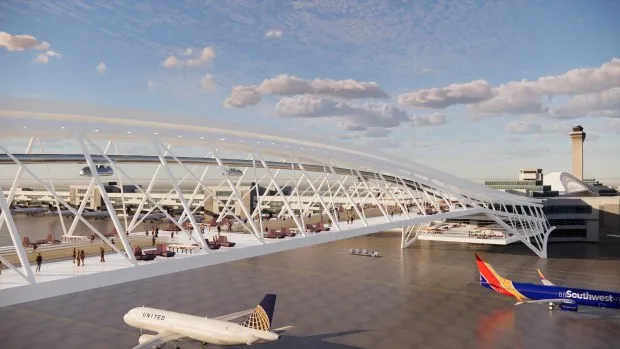 Photo: Denver International Airport, via www.denverpost.com
It started simply enough: Flight 447 to Chicago, delayed forty minutes due to "crew rest requirements." Standard stuff. I settled into my usual delay routine — overpriced airport sandwich, mindless phone scrolling, mild irritation at the gate agent who looked like she'd rather be literally anywhere else.
That's when I noticed them.
Three women in flowing scarves and sensible shoes, wheeling a cart decorated with motivational posters and what appeared to be a small gong. A hand-painted banner read: "Radical Listening Circle: Healing Travel Trauma Through Sacred Witness."
I should have run.
The Approach
"Excuse me," said the leader, a woman whose name tag read "Moonbeam" but whose LinkedIn probably said "Certified Trauma-Informed Empathy Facilitator." "I couldn't help but notice you're experiencing some displacement energy around this delay situation."
I looked around. Was she talking to me? I was literally just eating a turkey sandwich.
"We're offering complimentary emotional support for travelers who've been impacted by aviation disruptions," she continued, producing a laminated card titled "Signs of Travel Trauma: Are You Suffering in Silence?"
The symptoms included:
- Checking your phone repeatedly
- Eating airport food
- Feeling "mildly annoyed"
- Existing in an airport while experiencing a delay
Apparently, I was exhibiting all four.
The Intervention
Before I could politely decline, Moonbeam's associates had flanked me. "I'm Crystal," announced the woman to my left, "and I specialize in aviation-adjacent anxiety disorders." The woman on my right introduced herself as "Journey" and claimed expertise in "delayed departure grief counseling."
They had credentials. Certificates from something called the International Institute of Compassionate Transportation Studies. A three-day workshop in Sedona had apparently qualified them to diagnose my turkey sandwich consumption as a "maladaptive coping mechanism."
"We've created a safe space just over there," Moonbeam gestured toward a circle of folding chairs near the Starbucks. "It's completely voluntary, but we've found that travelers who don't process their delay trauma often carry that negative energy into their destination city."
She said this like it was a medical fact.
The Circle of Suffering
Somehow, I found myself sitting in a circle with five other "survivors" of Flight 447's forty-minute delay. There was Brad, a consultant whose connecting flight was now "maybe" tight. Susan, a grandmother whose gate had been changed twice. Mike, whose only crime was audibly sighing when the delay was announced.
"Let's begin with some grounding," Moonbeam instructed, producing a small bell. "I want everyone to take three deep breaths and really feel your feet on the airport carpet."
The carpet was sticky. I could definitely feel it.
"Now," she continued, "let's go around the circle and share our delay stories. Remember, this is a judgment-free zone. All travel trauma is valid travel trauma."
Brad went first. "I guess I just feel... frustrated? Like, I had a plan, and now that plan is disrupted."
The group murmured supportively. Crystal made notes on a legal pad titled "Trauma Indicators."
The Diagnosis
When my turn came, I made the mistake of honesty. "It's forty minutes. I'll grab another coffee, maybe finish this podcast. It's really not a big deal."
The circle fell silent. Moonbeam leaned forward with the expression of someone who'd just discovered a rare psychological specimen.
"That's textbook suppression," she whispered. "Classic delayed-onset travel trauma. You're intellectualizing to avoid feeling the full impact of your displacement experience."
Crystal nodded gravely. "We see this a lot. The 'I'm fine' defense mechanism. Very common in frequent flyers who've normalized aviation disruption as a survival strategy."
Journey produced a laminated sheet: "The Five Stages of Flight Delay Grief." Apparently, I was stuck in stage one (Denial) and desperately needed to progress through Anger, Bargaining, Depression, and finally, Acceptance of My Travel Trauma.
The Healing Begins
The next twenty minutes involved:
- A guided meditation where we "sent loving energy to the overworked flight crew"
- An exercise where we wrote angry letters to the airline (which we then "released" by tearing them up)
- A group affirmation that our time was "sacred and valuable"
- Something called "airplane pose yoga" that attracted stares from actual travelers
- A closing ceremony where we rang the bell and promised to "honor our delay experience"
Moonbeam gave each of us a small crystal "to carry the healing energy of our circle." Mine was supposedly charged with "patience and acceptance vibrations."
The Escape
"Flight 447 to Chicago is now ready for boarding," announced the gate agent.
I have never been so happy to hear those words in my life.
As I gathered my things, Moonbeam pressed a business card into my hand. "You've done beautiful work here today," she said. "But this is just the beginning. We offer follow-up sessions for post-flight integration."
The card advertised "Arrival Anxiety Counseling" and "Baggage Claim Trauma Recovery Workshops."
I mumbled something about being late and practically sprinted toward the boarding line.
The Aftermath
On the plane, I sat next to a woman who'd also been at our gate. "Did you see those therapy people?" she whispered. "They tried to convince me that being annoyed about my delay was actually 'unprocessed abandonment issues from childhood.'"
We shared a moment of solidarity — two survivors of the airport wellness industrial complex.
As we taxied away from Denver, I looked out the window and spotted them setting up their circle at another gate, where Flight 892 had just been delayed by twenty minutes. A new group of unsuspecting travelers was about to discover they were suffering from acute aviation displacement syndrome.
I still have the crystal. It sits on my desk as a reminder that in modern America, even the mildest inconvenience can be transformed into a billable therapeutic experience. Somewhere, there's probably a support group for people who've survived support groups.
And yes, I checked. The International Institute of Compassionate Transportation Studies is real. They have a website and everything.
God help us all.